
Business Intelligence vs AI for Distributors: What Actually Drives Revenue
Distributors are investing heavily in analytics, AI, and digital transformation tools. Yet many sales leaders are still asking the same question:
Why isn’t revenue growing faster?
The issue usually isn’t a lack of data. Most distributors already have valuable customer, sales, and operational data sitting inside their ERP systems.
What they struggle with is turning that information into consistent sales growth.
In this article, we’ll look at how distributors use BI and AI differently — and why connecting customer intelligence to sales workflows is what ultimately drives revenue growth.
Understanding Business Intelligence vs AI in Distribution
Although BI and AI are both forms of intelligence, they solve very different problems for distributors.
What business intelligence means for distributors
Business intelligence software helps distributors turn ERP, customer, and sales data into visibility around customer behavior, account performance, and revenue opportunities.
BI platforms help sales leaders answer questions like:
- Which customers are reducing spend?
- Where are margins declining?
- Which accounts have growth potential?
- Which reps are underpenetrating territories?
- What buying trends are emerging?
Solutions like White Cup BI help distributors surface these insights in a way that’s easier for sales teams and leadership to understand and act on. Instead of relying on intuition, distributors can make decisions based on real customer behavior.
What AI means in distribution
While BI explains what’s happening, AI helps distributors prioritize what sales teams should do next.
AI builds on business intelligence by identifying patterns, making predictions, and recommending actions.
For example, AI might identify customers at risk of churn based on declining order frequency, recommend cross-sell opportunities based on purchasing behavior, or help reps prioritize outreach based on revenue potential.
According to Gartner, AI-enabled sales technologies are helping organizations improve seller productivity, automate research and forecasting workflows, and surface better customer insights for sales teams.
But AI alone doesn’t automatically improve sales performance either.
Why the distinction matters
This is where many distribution organizations get stuck.
BI creates visibility.
AI creates predictive insight.
Neither one creates revenue on its own.
Without execution, dashboards and predictions remain passive information instead of revenue-producing activity.
How Distributors Use Business Intelligence Today
Turning ERP data into sales insights
ERP systems contain enormous amounts of customer intelligence, but the information is often difficult for sales reps to use in a meaningful way.
BI tools help distributors translate vast amounts of ERP data into visibility around:
- Customer buying trends
- Inactive accounts
- Margin erosion
- Product movement
- Territory performance
- Account growth opportunities
This gives sales leaders a clearer view of where revenue risks and expansion opportunities exist across the business.
Identifying customer trends and growth opportunities
One of BI’s biggest strengths is uncovering patterns that are difficult to spot manually. For example, distributors can use BI to identify:
- Customers buying one product category but not complementary products
- Accounts gradually reducing spend over time
- Seasonal purchasing shifts
- Reps missing high-potential expansion opportunities
These insights help teams prioritize where to focus, improve retention efforts, and increase share of wallet across existing accounts.
Supporting smarter sales decisions with real-time visibility
BI helps distributors move from reactive reporting to more proactive sales management. Instead of relying on intuition or delayed reporting, sales leaders can identify issues earlier, monitor customer behavior in real time, and make faster decisions about where teams should focus.
But visibility alone doesn’t guarantee action.
The limitation of BI alone
Dashboards don’t drive customer conversations. In many organizations, reps still have to manually review reports, prioritize outreach, and manage follow-ups on their own.
That creates a major gap between insight and execution.
BI can surface opportunities, but without workflow integration inside CRM, those insights often remain trapped in dashboards instead of becoming consistent sales activity.
Where AI Fits — and Where It Falls Short
AI has enormous potential in distribution sales, but many companies struggle to turn AI investments into measurable revenue growth.
Common AI use cases in distribution
Instead of asking reps to manually comb through reports every Monday morning, AI can surface which accounts are most likely to churn, which customers are primed for expansion, and which opportunities deserve immediate attention.
For distributors, AI is most valuable when it helps sales teams focus faster and act sooner. Common use cases include:
- Predicting at-risk customers before revenue declines further
- Recommending next-best products and cross-sell opportunities
- Prioritizing outreach based on buying behavior and account activity
- Improving forecasting accuracy
- Automating repetitive sales tasks and follow-up prompts
White Cup’s AI capabilities help distributors surface these opportunities faster by combining ERP, CRM, and customer behavior data into proactive recommendations.
AI depends on strong business intelligence
AI is only as effective as the quality of the underlying data feeding it. If ERP records are incomplete, customer information is inconsistent, or sales activity isn’t tracked properly, AI recommendations quickly lose value. That’s why strong business intelligence is foundational to successful AI initiatives.
Why AI alone often underperforms
Even with clean data, AI still needs an execution layer. An AI model can identify at-risk customers or cross-sell opportunities, but if sales reps never follow up, nothing changes. This is why many AI initiatives struggle to deliver ROI. The predictions exist, but they never become part of the sales workflow. AI without CRM becomes predictions with no execution.
Where CRM Fits Between BI and AI
This is the piece many distributors overlook. CRM isn’t separate from BI and AI. It’s the bridge between them.
Why insights don’t drive revenue without execution
Revenue growth doesn’t happen because a dashboard identified an opportunity. It happens when a rep calls the customer, schedules the meeting, follows up on the quote, or expands the account. Without execution, even the best insights remain passive information.
How CRM turns BI and AI into sales action
CRM operationalizes insights by embedding them directly into rep workflows. Instead of forcing sales teams to search through reports, CRM systems can:
- Trigger proactive outreach tasks
- Surface declining customer activity
- Push cross-sell recommendations into pipelines
- Automate follow-up reminders
- Track rep activity and accountability
For example:
- A rep sees a customer’s purchases declining and receives a CRM task to follow up
- Cross-sell recommendations appear directly inside an opportunity workflow
- High-risk accounts trigger proactive retention outreach
This is where solutions like White Cup CRM create measurable value for distributors. By connecting ERP data, BI insights, and AI recommendations into one workflow, distributors can move from passive reporting to active revenue generation.
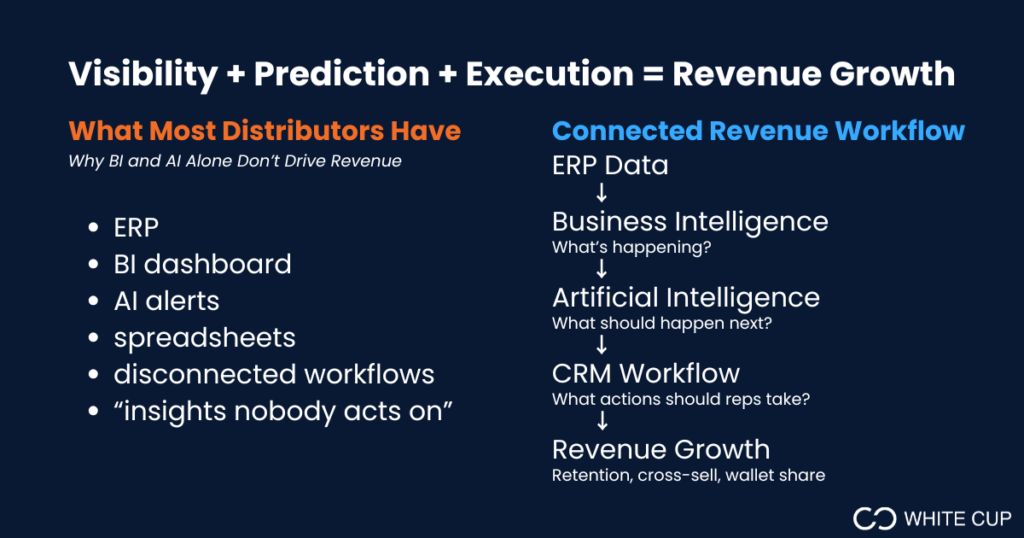
Connecting ERP, BI, AI, and CRM into one workflow
The most effective distributors don’t treat ERP, BI, AI, and CRM as separate systems. They connect them into one sales execution process:
- ERP provides operational data
- BI identifies trends and opportunities
- AI predicts risks and recommendations
- CRM drives execution and accountability
That combination creates measurable impact because it changes rep behavior — not just reporting visibility.
Business Intelligence vs AI: Which Actually Drives Revenue?
The answer is both — but only when connected through CRM execution.
BI helps distributors understand what’s happening across customers, products, and sales performance.
AI helps prioritize where teams should focus.
CRM ensures those opportunities become action.
The distributors seeing the strongest growth today aren’t necessarily the ones with the most advanced AI tools.
They’re the ones embedding customer intelligence directly into sales workflows so reps can consistently:
- Retain customers
- Expand accounts
- Increase share of wallet
- Improve follow-through
- Act faster on opportunities
That’s what ultimately drives revenue growth.
The Bottom Line for Distributors
Distributors don’t need more disconnected dashboards.
And they don’t need AI for AI’s sake.
They need connected systems that help sales teams take action on the right opportunities at the right time.
Business intelligence creates visibility.
AI creates predictive insight.
CRM turns both into revenue-producing execution.
The distributors winning today aren’t the ones chasing the newest technology trends. They’re the ones connecting customer intelligence directly to sales action.
When reps know which customers need attention, what opportunities exist, and what action to take next, revenue growth becomes far more repeatable.
Want to learn more about how White Cup helps distributors connect BI, AI, and CRM into one revenue-driving workflow? Explore White Cup CRM, White Cup BI, and White Cup AI solutions.
Written By
