AI Readiness for Distributors: How to Prepare Before Implementation
The race to adopt AI is creating a costly divide in distribution. The difference isn’t just between companies that have AI and those that don’t. It is between companies that can turn an AI-generated signal into a useful commercial action and those that can’t.
Consider this illustrative scenario. A distributor launches an AI tool to identify cross-sell opportunities. Within days, sales reps find outdated contacts, closed locations, and recommendations that ignore recent service problems stored in another system. Confidence disappears almost immediately.
The model may be sophisticated. But once sellers stop trusting its recommendations, it has little value. AI doesn’t repair fragmented data, inconsistent sales processes, or unclear ownership on its own. It can expose those weaknesses and make their consequences more visible.
AI readiness for distributors is the ability to use AI to improve a measurable business decision. It rests on four connected foundations: trustworthy data, connected systems, defined workflows, and prepared people. A distributor doesn’t need perfect data before it starts, but it does need enough reliable context to test a focused use case and judge the result.
What Is AI Readiness for Distributors?
AI readiness is an organization’s ability to implement, adopt, evaluate, and scale AI in support of a clear business outcome. In distribution, that means more than selecting a tool. The business must know which signal matters, who should see it, what action should follow, and how success will be measured.
Why readiness matters before implementation
An AI recommendation is only as useful as the data and workflow behind it. If account hierarchies are inconsistent, sales activity is incomplete, or a recent service issue lives outside the system the model can access, the recommendation may be incomplete or misleading. Even a technically accurate signal creates little value if nobody owns the follow-up.
The scale of the data challenge is well documented. In a July 2024 survey of 1,203 data-management leaders, Gartner reported that 63% of organizations either lacked or were unsure whether they had the right data-management practices for AI. Gartner also predicted that through 2026, organizations would abandon 60% of AI projects unsupported by AI-ready data.
For distributors, readiness reduces avoidable deployment risk. It also makes the evaluation more practical: Did the recommendation help a rep prioritize the right account, recover an open quote, notice a slowing reorder pattern, or protect a customer relationship?
Readiness does not require perfect data
Readiness should not become an excuse to wait until every system is modernized and every record is pristine. Start with the data required for one useful decision. AI can also help identify inconsistencies, but the business still needs an owner, a standard, and a process for resolving them.
The notion that your data needs to be perfect is a common AI myth for distributors. Your data doesn’t need to be perfect, but you do need to understand what your chosen use case requires.
The Four Components of AI Readiness
1. Trustworthy, accessible data
Begin with the records that shape a commercial decision: customer and branch relationships, ship-to and bill-to structures, product and order history, open quotes, contract pricing, sales activity, service issues, and account ownership. The relevant fields should be sufficiently complete, consistently defined, and accessible to the approved AI workflow.
Ask:
- Are customer, branch, and account records standardized across systems?
- Is sales activity captured consistently enough to add context to transaction history?
- Can the business explain where each critical field comes from and who maintains it?
- Are revenue, margin, churn risk, and opportunity stages defined consistently?
If ownership or standards are unclear, use a practical CRM data-governance process for distributors to establish them before the pilot expands.
2. Connected business systems
For many distributors, no single system contains the full customer story. The ERP records transactions, pricing, inventory, and order history. CRM captures relationships, activities, opportunities, and follow-up. BI makes buying patterns, customer trends, margin, and performance easier to see. AI needs access to the right combination for the question you’re expecting it to answer.
A useful readiness review should map how information moves between these systems, where latency or duplication occurs, and which source is authoritative. Learn more about the role of ERP and CRM integration for distributors.
3. A defined workflow and decision owner
Do not begin with a broad goal such as ‘use AI for sales.’ Begin with a decision. For example: Which HVAC contractor accounts have slowed their normal reorder cadence, and which account owner should investigate this week? Then define where the signal appears, what supporting evidence the rep can inspect, what action is expected, and how the result is recorded.
This is where insight becomes sales execution. A dashboard, alert, or conversational answer creates commercial value only when someone can use it to prioritize an account, prepare for a customer visit, recover a quote, protect margin, or coordinate a handoff.
4. Prepared people and practical governance
Sales operations, IT, sales leadership, and frontline users need a shared understanding of the use case and their responsibilities. Users should know what the AI can access, how to challenge a weak recommendation, when human judgment takes priority, and where to report a problem.
The NIST AI Risk Management Framework emphasizes defined roles, testing, measurement, and monitoring throughout the AI lifecycle. Those practices are useful even for a narrow commercial pilot: assign an owner, define expected behavior, test the output in context, and monitor performance after launch.
Change management also belongs in the readiness plan. A 2025 McKinsey survey found that workflow redesign had the largest effect among 25 tested attributes on respondents’ ability to report EBIT impact from generative AI. The lesson for distributors is practical: fit the signal into real work, train people for their role, and measure whether they use it.
How Can Distributors Assess AI Readiness?
Review one proposed use case against the checklist below. Mark each item as ready, needs work, or unknown. An unknown is not a failure, but it should have an owner before the pilot begins.
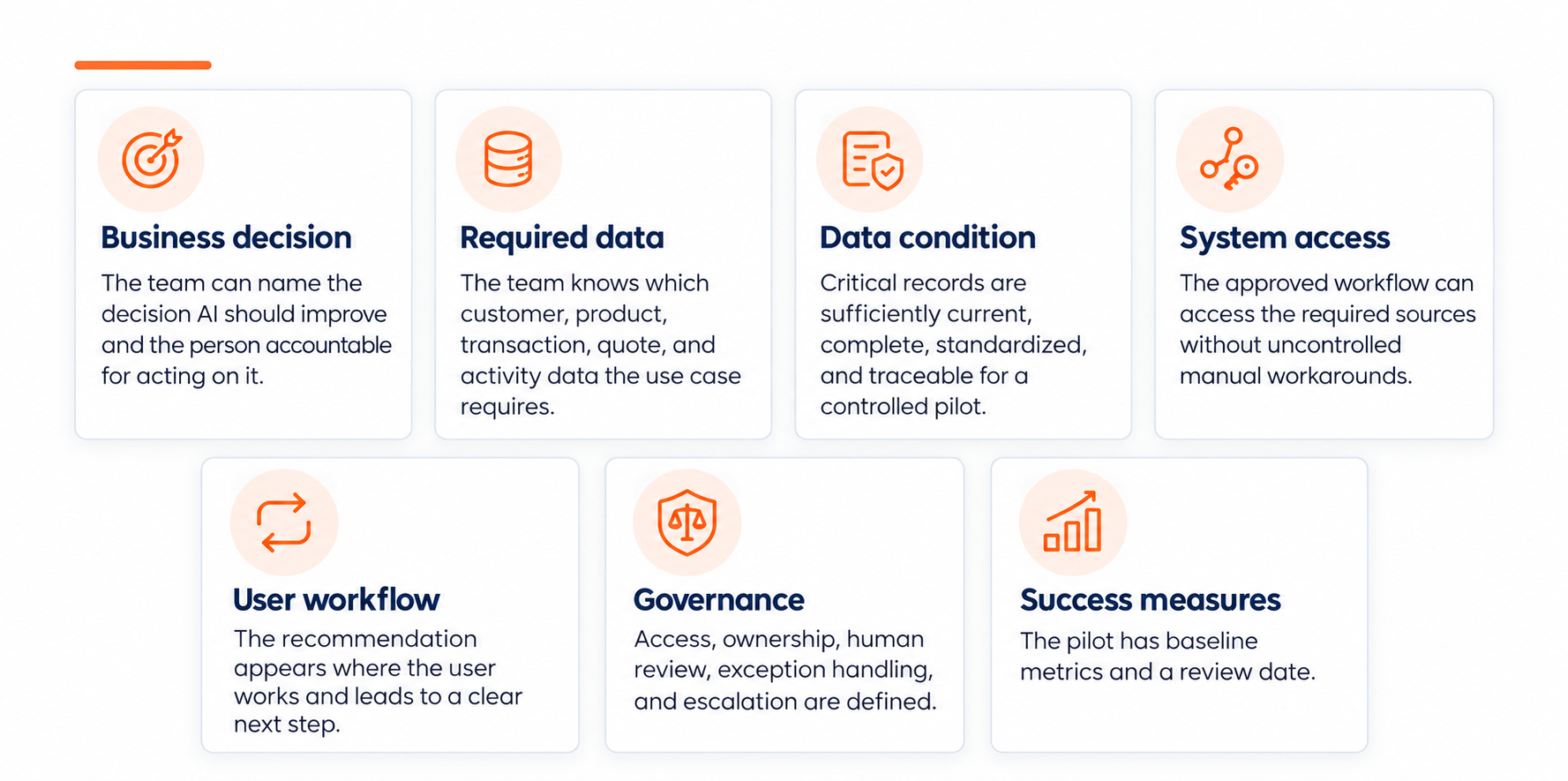
Common AI Readiness Challenges in Distribution
Disconnected data narrows the answer
AI can’t evaluate the full commercial picture when customer, sales, service, and operational data lives in separate systems. But you don’t need to connect every source before you begin. Start with the first use case, identify the data required to support that decision, and document any gaps that could materially affect the answer.
The project starts with a platform, not a decision
A technology-first project may produce an impressive demonstration without improving anyone’s day-to-day work. Start with the decision instead: What does the user need to know? What should they do next? What measurable outcome would justify expanding the pilot? Those questions keep the project tied to a real sales or service workflow.
Users can’t see what supports the recommendation
A rep is more likely to investigate a cross-sell opportunity when the recommendation includes the evidence behind it, such as order history, a missing product category, an open quote, or a change in reorder cadence. Training helps, but usefulness earns adoption. Give users enough context to apply their judgment instead of asking them to trust an unexplained score.
For more guidance on building AI into the team’s daily workflow, read White Cup’s article on AI sales tool adoption.
How to Build an AI Readiness Roadmap
- Choose one valuable decision. Select a use case with a clear owner, meaningful business value, and a result the team can observe within a defined period.
- Map the required data. Identify the fields, systems, definitions, and quality thresholds needed for that decision. Do not expand the scope without a clear reason.
- Prepare the workflow. Decide where the recommendation appears, what evidence accompanies it, who acts, and how feedback is captured.
- Run a controlled pilot. Start with a representative group of users or accounts. Compare the output with actual account context and document exceptions.
- Measure behavior and outcomes. Track recommendation quality, seller adoption, completed follow-up, time saved, qualified opportunities acted on, and the commercial result relevant to the use case.
- Scale what works. Expand only after the team understands why the pilot worked, which dependencies matter, and what governance is required at greater volume.
Potential starting points include customer segmentation, cross-sell opportunity identification, slowing reorder detection, quote follow-up, pipeline review, and retention analysis. White Cup’s guidance on CRM customer segmentation for distributors provides one example of turning customer and transaction signals into a prioritized sales action.
AI Success Starts with a Measurable Decision
Access to AI is not a lasting advantage by itself. Your competitors can always buy similar tools. A more defensible advantage comes from understanding your customers, maintaining useful transaction history, defining how your team responds to a signal, and improving that process over time.
Do not begin only by asking, ‘Which AI platform should we buy?’ Ask a harder and more valuable question: ‘What must be true inside our business for AI to produce a result we can measure?’
White Cup helps distributors use customer and transaction data to identify revenue opportunities and give commercial teams useful context for their next action. Ready to find out where your organization stands? Contact us to schedule an AI readiness assessment with one of our distribution technology experts.
Written By